
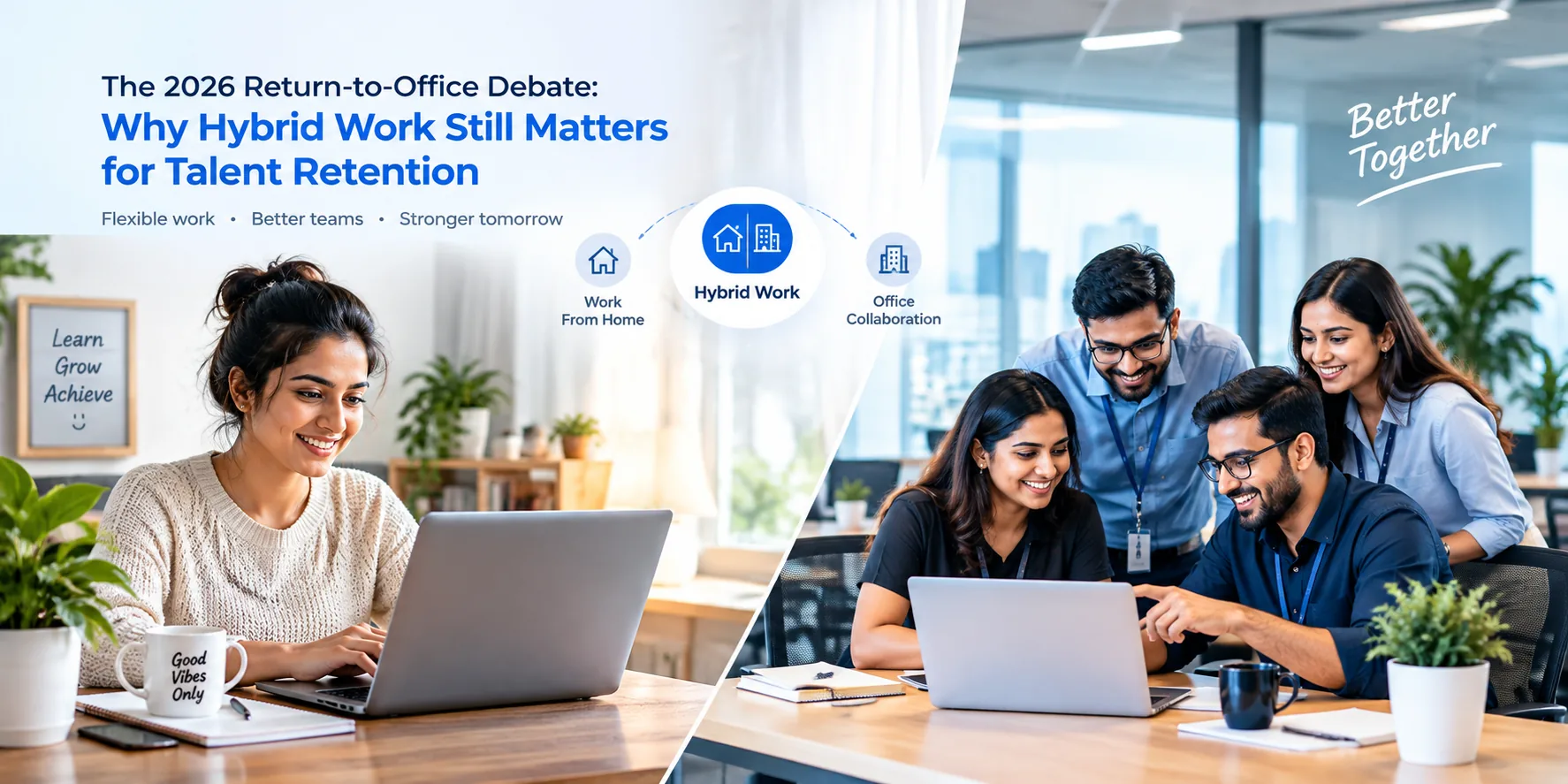
The Return-to-Office Debate Is Changing
The workplace in India is changing again. After several years of widespread remote work, many companies are increasing office attendance requirements while employees continue to value flexibility.
This has created an important question for employers: how can companies bring teams together without making workplace flexibility a reason for talented employees to leave?
The answer is increasingly about finding the right balance between collaboration, productivity, employee experience and business requirements.
Hybrid work is therefore becoming more than a simple compromise between working from home and working from an office. It is becoming a strategic part of how companies think about hiring and retaining talent.
Why Companies Are Returning to the Office
The return-to-office movement is happening for several reasons. Companies may want stronger team collaboration, easier communication, better training, closer customer interaction and greater coordination between departments.
Some roles also require employees to work with physical infrastructure, sensitive information or customers directly.
However, not every job requires the same level of physical presence. A software developer, sales executive, customer-support specialist and laboratory technician may all have very different workplace requirements.
This is why many organizations are moving toward role-based workplace policies instead of applying exactly the same model to every employee.
Why Employees Still Value Hybrid Work
For employees, workplace flexibility can influence more than convenience. Working from home for part of the week can reduce commuting time and provide greater flexibility for managing personal responsibilities.
At the same time, office days can provide opportunities for face-to-face collaboration, team interaction and professional networking.
The result is a workplace model that attempts to combine the advantages of both environments.
However, hybrid work does not automatically improve employee satisfaction or retention. Its effectiveness depends on how clearly the company defines expectations and how well teams communicate.
Hybrid Work and Talent Retention
Talent retention has become an important part of the hybrid-work discussion.
Employees evaluate jobs based on several factors, including compensation, career growth, management, workload, company culture and workplace flexibility.
A company offering flexible work may therefore attract candidates who place a high value on location flexibility.
On the other hand, employees who prefer regular face-to-face collaboration may value an office-first environment.
The key for employers is understanding what their workforce needs rather than assuming that one workplace model will work for everyone.
How Workplace Policy Can Affect Hiring
Workplace policy can also influence the size of a company's potential talent pool.
A company that requires employees to work from an office every day may primarily attract candidates who live within commuting distance.
A company offering hybrid or remote opportunities may be able to consider candidates from a wider geographic area.
For recruiters, this makes work mode an important part of a job description. Candidates should be able to understand whether a position is remote, hybrid or office-based before they apply.
Clear information can reduce misunderstandings between employers and candidates during the hiring process.
Hybrid Does Not Mean Completely Flexible
Hybrid work does not necessarily mean employees can work from anywhere at any time.
Many organizations use structured hybrid schedules. For example, employees may work from the office three days a week and remotely for the remaining days.
Other companies may allow teams to decide which days they meet in person.
The right arrangement depends on the role, team structure, customer requirements, security needs and business operations.
What matters most is that expectations are communicated clearly to employees before they join the organization.
The Shift From Attendance to Outcomes
One of the biggest challenges of hybrid work is measuring productivity.
Traditionally, managers could associate physical office presence with working time. Hybrid teams require organizations to think more carefully about outcomes.
Instead of focusing only on how many hours an employee spends inside an office, companies can also evaluate project completion, quality of work, customer satisfaction, deadlines and progress toward team goals.
This creates an opportunity to move from attendance-based management toward outcome-based management.