
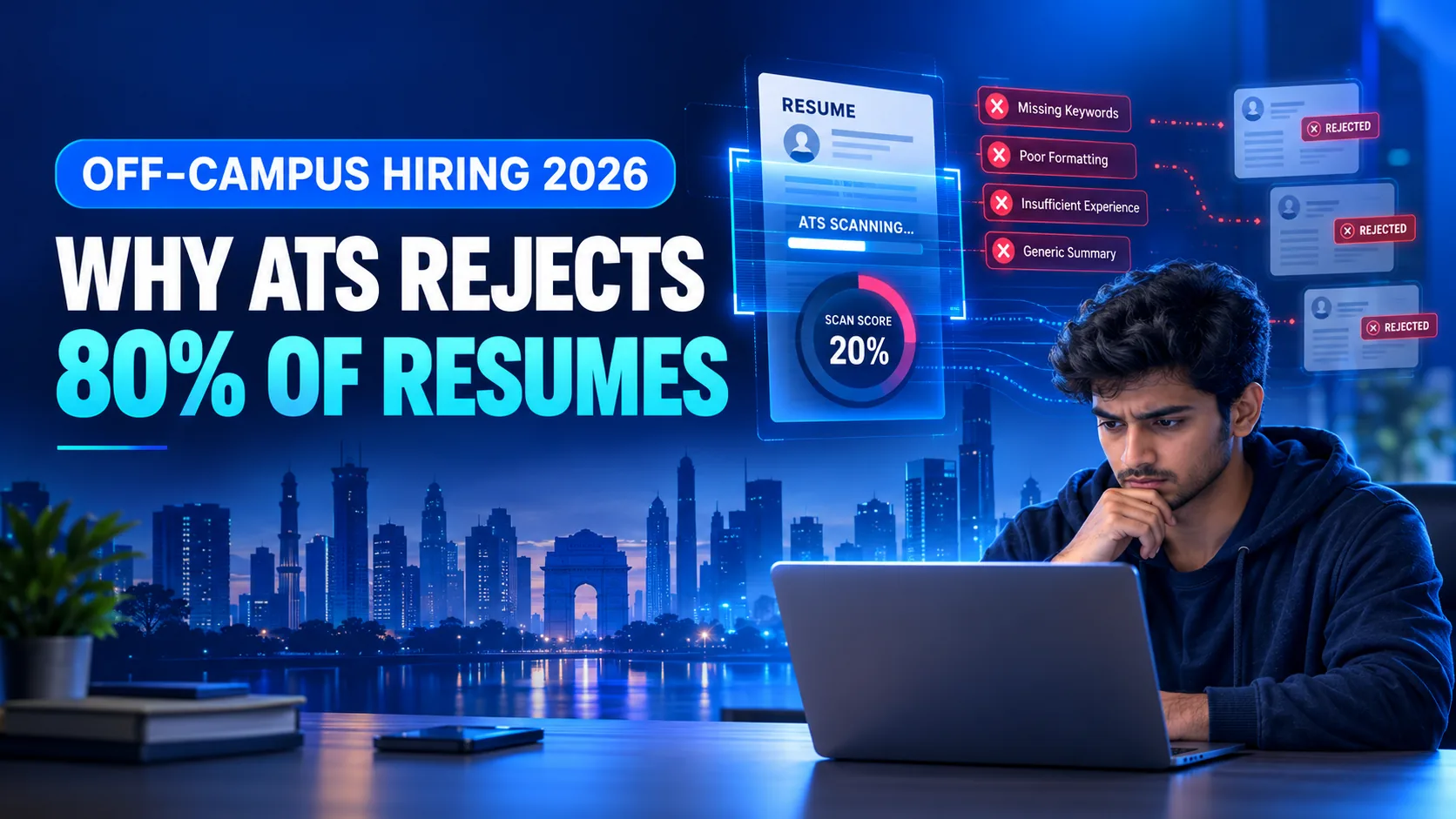
1. Off-Campus Hiring 2026: Why ATS Rejects 80% of Indian Resumes
You find a job opening that matches your skills. You update your resume, write down your achievements, and click Apply.
Then you wait.
A few days pass. Nothing happens. You apply to another company, then another. Sometimes you receive an automated rejection. Other times, you never hear back.
If you are a fresher searching for off-campus opportunities in India, this experience may feel frustratingly familiar.
It is easy to assume that your resume was rejected by an Applicant Tracking System (ATS). But the reality is more complicated. Your application may not match the role, the employer may have received too many applications, or the recruiter may still be reviewing candidates.
The claim that ATS rejects 80% of Indian resumes should not be treated as a verified industry-wide statistic without a reliable source. However, understanding how resume screening works can help you avoid common mistakes and present your qualifications more effectively.
Let's break down what ATS software does, why resumes can get overlooked, and how you can improve your chances of getting noticed during off-campus hiring in 2026.
2. What Is an ATS, and Why Do Companies Use It?
An Applicant Tracking System is a software platform that helps companies manage their hiring process.
Imagine a company posts an entry-level software developer position and receives hundreds of applications. Reviewing every resume manually can take considerable time.
An ATS helps recruiters organise applications, track candidates through different hiring stages, search for relevant qualifications, and manage communication.
Depending on the platform and the employer's configuration, it may also extract information from resumes, support screening questions, or help recruiters identify candidates who meet particular requirements.
But here is something important to understand: an ATS is not one universal robot that rejects every resume that fails to meet a fixed score.
Different companies use different systems, settings, and recruitment processes. Some rely heavily on recruiter searches and application questions, while others use more automated screening features.
That is why the best strategy is not to write your resume for a mythical universal ATS. It is to make your qualifications easy to understand and relevant to the specific job.
3. Why Your Resume May Not Be Getting Shortlisted
Applying for jobs but not getting interview calls? Sometimes, small mistakes in your resume can make a difference.
Missing keywords: Your resume may not mention the skills required for the job.
Complicated formatting: Fancy designs or multiple columns can make your resume harder to read.
Weak project details: Simply listing projects isn't enough. Explain what you built and what you learned.
Too many generic skills: Focus on skills that are relevant to the role.
Applying for the wrong roles: Always check the job requirements before applying.
Remember: You don't need a perfect resume. You need one that clearly shows your skills and matches the job you're applying for.