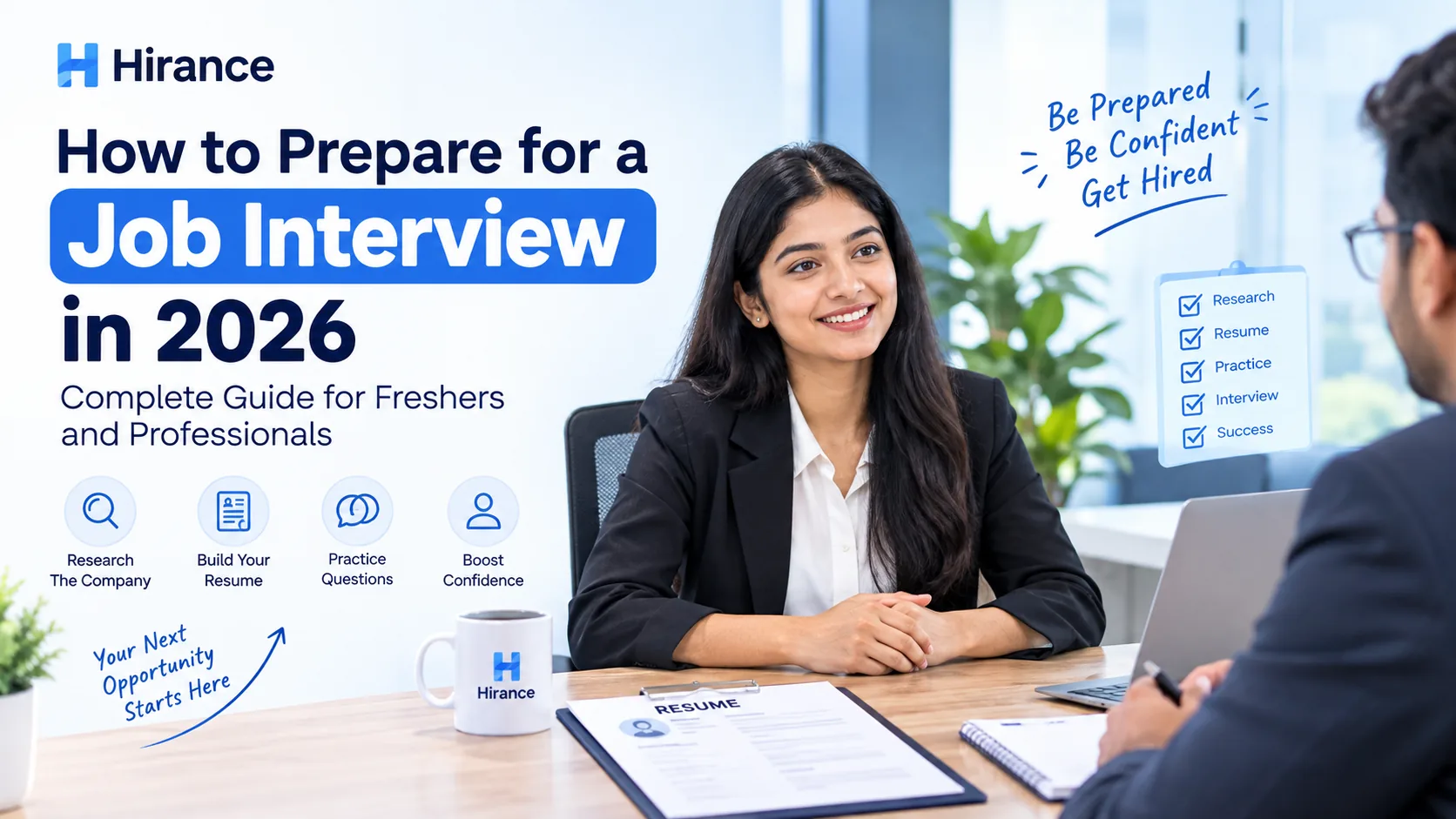
How to Prepare for a Job Interview in 2026
A job interview is an opportunity for both the candidate and the employer to understand whether the role is a good match.
Good preparation can help you communicate your experience, explain your skills, discuss your projects, and respond to questions more confidently.
Whether you are attending your first interview as a fresher or preparing for a new role as an experienced professional, having a clear preparation strategy can make the process more organized.
1.Understand the Job Description
Start your preparation by reading the job description carefully.
Identify the main responsibilities, required skills, experience requirements, technologies, and qualifications.
Make a list of the requirements and compare them with your own experience.
For example, if a position requires React, JavaScript, REST APIs, Git, and responsive design, prepare examples from your projects or professional experience where you used these skills.
Understanding the role also helps you ask better questions during the interview.
2.Research the Company
Before an interview, spend some time learning about the organization.
Understand what the company does, what products or services it offers, who its customers are, and what type of role you are applying for.
You don't need to memorize everything about the company.
Focus on information that helps you understand the position and explain why the opportunity interests you.
Being familiar with the organization can also help you have a more meaningful conversation with the interviewer.
3. Prepare Your Introduction
HR interviews often include questions designed to understand your communication, experience, career goals, and approach to different situations.
Common questions include:
Tell me about yourself.
Why are you interested in this role?
Why do you want to work with our company?
What are your strengths?
What is an area you are working to improve?
Tell us about a challenging situation you handled.
Where do you see your career developing?
Don't memorize answers word for word. Instead, prepare the key points you want to communicate.
4. Prepare for Common HR Questions
HR interviews often include questions designed to understand your communication, experience, career goals, and approach to different situations.
Common questions include:
Tell me about yourself.
Why are you interested in this role?
Why do you want to work with our company?
What are your strengths?
What is an area you are working to improve?
Tell us about a challenging situation you handled.
Where do you see your career developing?
Don't memorize answers word for word. Instead, prepare the key points you want to communicate.
5. Use Real Examples When Answering Questions
When possible, support your answers with real examples.
Instead of saying "I am good at problem solving," describe a situation where you actually solved a problem.
Explain the situation, what you needed to accomplish, what action you took, and what happened as a result.
For example, you might explain how you identified a performance issue in an application, investigated the cause, implemented a solution, and measured the improvement.
Real examples make your answers more specific and easier for an interviewer to understand.
6. Prepare for Technical Interviews
Candidates applying for technical positions should revise the fundamentals related to their role.
For software development positions, preparation may include programming fundamentals, data structures, databases, APIs, Git, system concepts, frameworks, and problem solving.
Be prepared to explain your own projects.
Interviewers may ask why you selected a particular technology, how you designed a feature, what problems you encountered, and how you solved them.
Understanding your own work is often just as important as knowing theoretical concepts.
7. Prepare Your Projects
Your projects can provide some of the best examples of your practical skills.
For every important project, be ready to explain:
What problem does the project solve?
What technologies did you use?
What was your specific contribution?
What challenges did you face?
How did you solve those challenges?
What would you improve if you built it again?
This is particularly important for freshers because projects can demonstrate practical knowledge even when professional experience is limited.
8. Practice Without Memorizing
Practice answering questions before the interview, but avoid memorizing complete sentences.
The goal is to become comfortable explaining your experience naturally.
You can practice with a friend, record yourself, or conduct a mock interview.
Pay attention to your speaking speed, clarity, unnecessary filler words, and whether your answers actually address the question.